
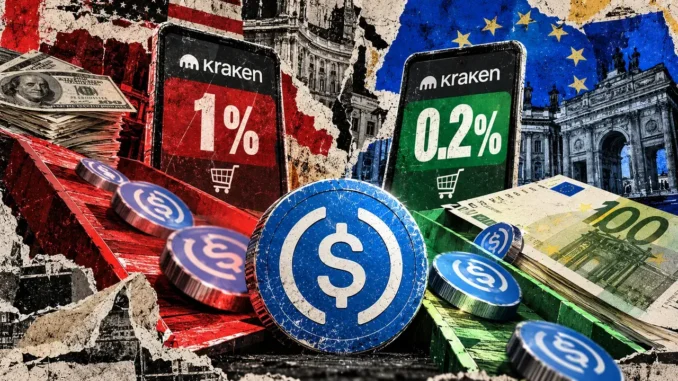
Converting $10,000 of the dollar stablecoin USDC into euros can incur a $100 or $20 trading fee at Kraken, before execution and withdrawal costs.
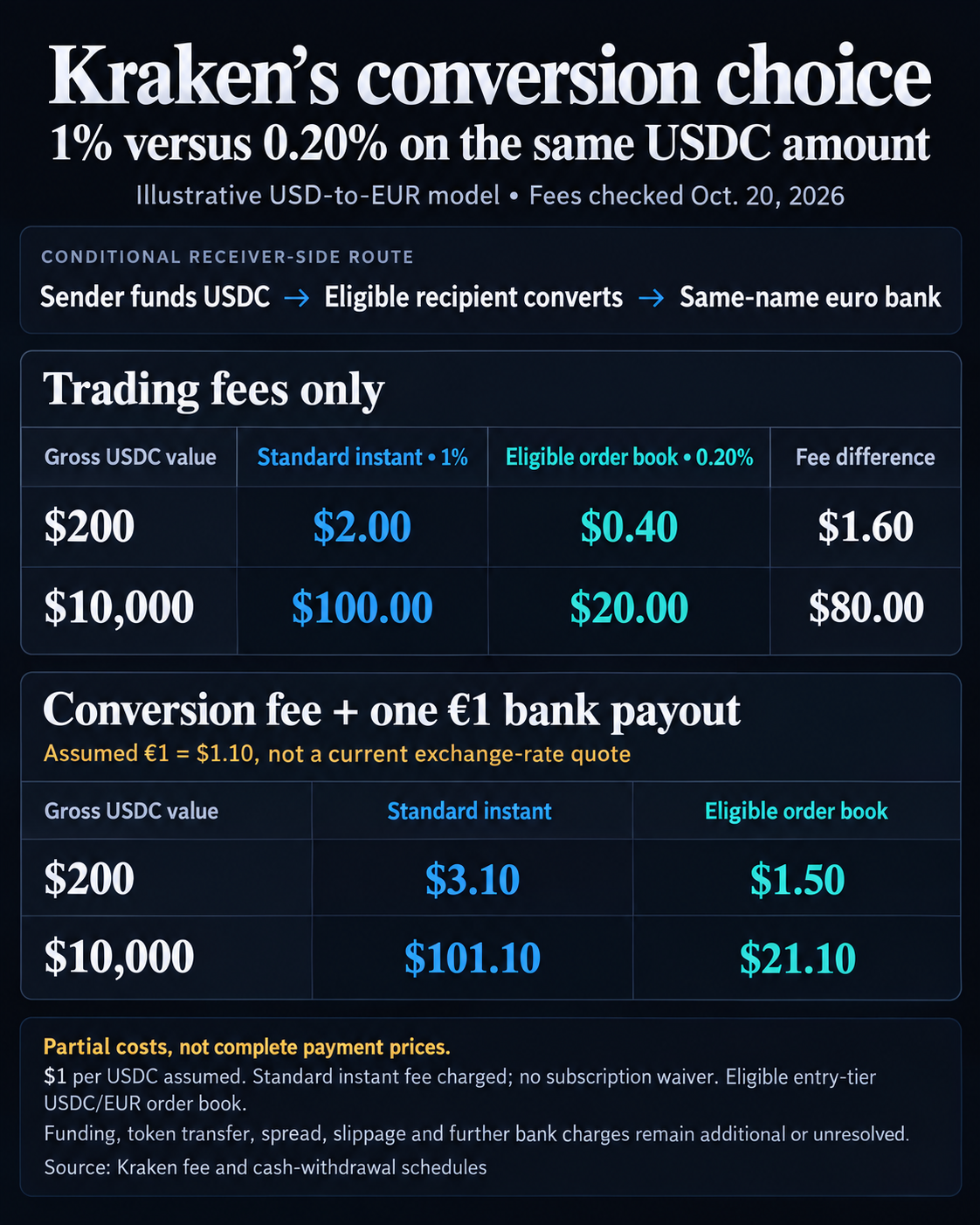
The $80 difference comes from standard Instant Buy/Sell pricing versus the eligible entry-tier USDC/EUR order book, using the exchange’s fee schedule checked Oct. 20.
At $200, the same 80-basis-point gap is worth $1.60. A fixed bank payout charge then takes a much larger share of the transfer, leaving less room for the stablecoin route to compete with a money-transfer company.
The Bank for International Settlements published Working Paper 1385 on Oct. 19. Wenxin Du, Catherine Huang and David Scharfstein compare banks, fintech transfer providers and stablecoin routes.
Their summary reports median costs of around $40-$60 for $10,000 transfers from the US across developed-market currency groups. The authors’ separation of exchange-rate markups from explicit fees provides a framework for testing how much the conversion product can impact.
The competitive question is how many euros reach the recipient’s bank for the sender’s complete dollar outlay. A lower exchange fee changes that calculation, but funding, token movement, execution and payout still have prices of their own.
Where the conversion price changes the bill
Kraken’s standard instant and recurring trades carry a 1% trading fee, with a variable spread embedded in the price and possible payment-method fees. Its advertised USDC/EUR market offers a different execution route: an order book where USDC is the base asset being exchanged for euros.
For an eligible trade in that market, the standard stablecoin/FX schedule starts at 0.2% for both maker and taker orders. Kraken’s stablecoin fee explanation distinguishes this from markets where a stablecoin is only the quote currency.
The comparison also assumes the standard instant fee is actually charged. Kraken+ can waive qualifying instant trading fees on up to $10,000 in monthly trading volume, while spreads and card processing charges remain.
Kraken’s specified Convert features offer USD-to-USDC and USDC-to-USD conversions at 1:1, without a spread or conversion fee, up to $100,000 daily in each direction. A model using that eligible feature should not automatically charge 1% to acquire USDC with dollars, and the exemption does not make the subsequent conversion from USDC into euros free.
For a payment to another person, consider a receiver-side route: the sender acquires and sends the dollar stablecoin USDC, and the recipient converts it through their own eligible Kraken account before withdrawing to a bank account in their name.
Kraken’s same-name withdrawal requirement makes that account structure part of the comparison.
Now hold the gross USDC arriving for euro conversion constant at a value of $200 or $10,000, using $1 per USDC solely for illustration. Funding, acquisition, token withdrawal and network charges, execution spread, slippage and further bank charges are additional or unresolved.
Kraken’s withdrawal schedule lists a €1 SEPA bank payout through Bank Frick or Banking Circle, subject to eligibility, with a €2 minimum. Assume that one payout applies and translate it at €1=$1.10 solely for the calculation.
Illustrative cost component$200 conversion$10,000 conversionStandard instant trading fee, 1%$2.00$100.00Eligible order-book trading fee, 0.20%$0.40$20.00Difference in trading fee alone$1.60$80.00One €1 payout at the assumed rate$1.10$1.10Instant conversion fee plus payout$3.10$101.10Order-book conversion fee plus payout$1.50$21.10
These subtotals include only the stated conversion fee and one payout. The unresolved route costs have not been assigned a zero value.

Now introduce an entirely hypothetical fintech price of 0.50% all-in. At $200, that hypothetical competitor costs $1. Both Kraken conversion-plus-payout subtotals already exceed it, before any additional nonnegative route costs and without a favorable exchange-rate offset.
At $10,000, the hypothetical competitor costs $50. The order-book subtotal leaves $28.90 for additional net route costs before reaching that price. The standard instant subtotal already exceeds $50 before any favorable exchange-rate offset.
A fixed euro payout weighs much more heavily on $200, while the percentage conversion charge dominates the larger example. The $80 remains a fee-only difference on an identical $10,000 conversion amount.
A sender whose earlier charges reduce the amount arriving for conversion needs a different complete-route calculation.
The recipient must be able to use the route
A payment to another person requires more than selling USDC and withdrawing euros from the sender’s own exchange account. Kraken’s third-party payment policy requires a bank withdrawal account in the verified Kraken holder’s name.
The recipient’s verified account must support the asset, conversion, and bank payout, while the sender’s acquisition venue and transfer network must also be available and priced. A public USDC/EUR market listing establishes none of those individual permissions.
Two people can face different access requirements even when both can see the same advertised trading rate.
Kraken’s regional restrictions make location and product access material. Eligibility for a trading pair, a funding method and a payout provider cannot be inferred from the existence of a public conversion page.
The receiving burden differs from Wise’s advertised US-to-Europe bank-transfer service, as Wise says the recipient needs local bank details but does not need a Wise account. An exchange-based route requires the recipient to use an additional account and conversion process.
For a sender funding a Kraken account, the deposit method also changes when money can leave. Kraken’s cash deposit table lists US ACH Plaid deposits as free and near-instant for trading, but with a seven-day withdrawal hold covering crypto and fiat.
It lists eligible US Dart Bank FedWire deposits as free at Kraken, with a 0-1-business-day processing estimate and no listed withdrawal hold.
At the other end, the €1 standard SEPA methods have estimated processing times of 0-5 business days. Listed instant alternatives include €1 through Banking Circle and €0.90 through ClearJunction, with differing minimums and availability.
Bank checks can delay even an instant option, and Kraken directs customers to their signed-in funding screen for current applicable terms.
Those stages explain why a fast token transfer and immediate access to euros are different measurements. The BIS authors likewise distinguish foreign-exchange markups from explicit exchange, blockchain, and fiat-withdrawal costs, and describe conversion and bank processing as potential delays.
What a matched quote could establish
Wise’s comparison methodology estimates rivals’ displayed rates using earlier markups and a newer Bloomberg midpoint, sometimes applying a higher collected amount threshold.
For a matched observation, the net euro receipt can be translated back into dollars using a contemporaneous benchmark expressed in euros per dollar, then subtracted from the sender’s total dollar debit.
The illustrative rankings show why the $200 payment is more exposed to a fixed payout charge, while product choice creates a larger dollar allowance at $10,000. Whether that allowance becomes a cheaper payment depends on usable accounts, remaining costs, and the euros that finally arrive.


Be the first to comment