

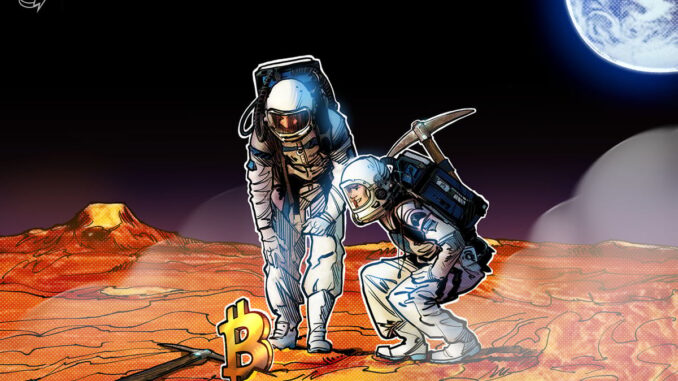

Starcloud, an Nvidia-backed orbital data center startup, said it will start mining Bitcoin from space later this year when its second spacecraft is launched, positioning it to become the first company to mine Bitcoin off Earth.
Starcloud “will be the first to mine Bitcoin in space,” the startup’s CEO, Philip Johnston, posted to X on Saturday after revealing its Bitcoin mining ambitions in space in an interview with HyperChange on Thursday.
In the interview, Johnston said running Bitcoin application-specific integrated circuit (ASIC) miners would be “one of the most compelling use cases” of space compute due to it being significantly cheaper than GPUs.
“GPUs are about 30 times more expensive per kilowatt or per watt than ASICs,” Johnston said. “A 1-kilowatt B200 chip, it might cost $30,000. A 1-kilowatt ASIC is like $1,000.”

Clip on Bitcoin mining pic.twitter.com/WXlp1BMya1
— Philip Johnston (@PhilipJohnston) March 8, 2026
In the X post, Johnston said Bitcoin mining in space will become a “massive industry” due to how much more economical it is than mining the cryptocurrency on Earth.
“Bitcoin mining consumes about 20 GW of power continuously. It makes no sense to do this on Earth, and in the end state, all of this will be done in space.”
Starcloud was founded in early 2024 to build data centers in space as a solution to address rising energy needs for AI. In November, it launched a satellite with an NVIDIA H100 into orbit, marking the first time a GPU that powerful has ever operated in space.
Its data centers, which comprise around 88,000 satellites, are primarily powered by solar energy.
Sending Bitcoin to Mars
While Johnston’s Starcloud envisions mining Bitcoin in space, tech entrepreneurs Jose E. Puente and Carlos Puente last year came up with a solution to send it across planets.
In September, Puente told Cointelegraph that it is theoretically possible to send Bitcoin to Mars in as fast as three minutes by leveraging an optical link from NASA or Starlink and a new interplanetary timestamping system.
While someone would need to be there to receive it, the Bitcoin transaction would move through space stations — such as antennas and satellites — or even a relay around the Moon before reaching Mars.
However, they said mining Bitcoin on Mars would not be feasible due to the latency between the two planets.
Related: Bitcoin drops 2% as oil prices surge on energy shortage fears
Bitcoin mining profitability margins have thinned over the past few months, particularly due to Bitcoin’s (BTC) price falling nearly 48% from its $126,080 high on Oct. 6.
However, the Bitcoin mining difficulty has fallen 7% from a record 155.9 trillion units in November to 145 trillion, giving miners some much-needed breathing room for now.
Magazine: The debate over Bitcoin’s four-year cycle is over: Benjamin Cowen



Be the first to comment